


Never Too Late: Starting Martial Arts in Your 40s, 50s, and Beyond

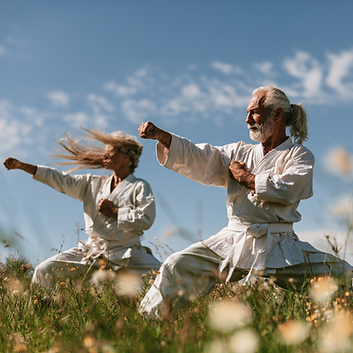
The thought crosses your mind somewhere between your third cup of coffee and your fourth hour in the same chair: I should do something different.
Maybe you've watched a martial arts film, seen a friend post about their judo class, or simply felt the quiet frustration of a body that doesn't move the way it once did. Perhaps you've taken your kids or grandkids to a local Shotokan or Jiu Jitsu center and found yourself wishing you'd learned martial arts at their age. Whether you've discovered a latent desire to learn martial arts and/or self-defense, or you're craving genuine friendships and face-to-face connection in a world that has retreated behind computer screens and remote work, or you simply wish for a more confident and healthy lifestyle—the feeling underneath it all is the same—a quiet wish for 'more.' And wishing for more when it comes to martial arts fosters the inevitable question—am I too old for this?
The honest answer is no. But let's start with the truth about where many of us are starting from.
Approximately 25% of all American adults (regardless of profession) sit for more than 8 hours a day, and 44% of those highly sedentary individuals reported getting zero moderate-to-vigorous physical activity during the week. Individuals who predominantly sit at work face a 16% higher risk of all-cause mortality and a 34% higher risk of cardiovascular disease compared to those who do not (JAMA Network 2024). Years of desk work do a particular kind of quiet damage. The hip flexors — those deep muscles connecting your spine to your thighs — shorten and tighten from constant sitting, pulling your pelvis forward and straining your lower back. Your glutes, designed to be powerful movers, essentially go to sleep from disuse. The posterior chain — hamstrings, lower back, rear shoulders — weakens while the chest and front shoulders pull forward, rounding your posture. Core stability, which isn't just your abs but the entire girdle of muscles surrounding your spine, becomes shallow and unreliable. You may not feel broken, but your body has been quietly negotiating around these imbalances for years.
This is precisely where martial arts becomes medicine for your mind, body and spirit.
Standing or upright martial arts, like Shotokan karate and Muay Thai for example, reawaken the body from the ground up. Every basic stance in Shotokan demands that your hips open, your glutes fire, and your spine stack properly— essentially undoing years of chair posture in a single practice session. Muay Thai adds dynamic hip rotation, shoulder engagement, and cardiovascular conditioning that most gym routines can't replicate because it's purposeful movement, not mechanical repetition. You aren't just burning calories; you're learning to use your body as a coherent, coordinated and integrated system.
Grappling arts like judo and Brazilian jiu-jitsu address a different and equally important dimension. Judo builds explosive hip power and balance awareness, teaching you to move another person's weight — which first requires understanding your own. Jiu-jitsu, particularly appealing to older beginners, rewards patience, leverage, and technique over raw strength. On the mat, a 55-year-old with good positioning can genuinely control a younger, stronger opponent. The posterior chain rebuilds, grip strength returns, and spatial awareness sharpens in ways no treadmill can offer.
The self-defense aspect is real and practical, but most longtime practitioners will tell you it becomes secondary to something much harder to name. You will earn bruises and breakthroughs in equal measure. You will bow alongside a 22-year-old and a 68-year-old and find common language. The dojo becomes one of the rare spaces in modern life where effort is visible and honesty is required.
Certainly, earning a black belt in an art matters — the discipline it represents is genuine. But students who stay and practice long enough will discover something quieter and more lasting on the other side of the accomplishment: a recalibrated patience, a new fluency in reading people, and an earned comfort in their own skin that no office achievement ever quite delivers.
And what about those who once trained martial arts long ago, perhaps achieving the rank of black belt, but walked away from the practice for several months or years? Starting all over again, putting on that white belt, can be intimidating — and downright daunting. There is a Japanese word that many experienced martial artists learn to understand and embrace: Soshin. Rooted in Zen philosophy, Soshin — or "beginner's mind" — is the practice of approaching any endeavor, even one you've mastered before, with the openness, curiosity, and humility of someone experiencing it for the very first time.
For a black belt deciding to return to training, Soshin is not a retreat or a defeat. It is a deliberate and deeply meaningful choice — a willingness to set aside what you once knew long enough to discover what you may have missed the first time, and perhaps most importantly, what has changed inside the person you are now. That white belt is not so much a symbol of starting over but an invitation to go further than you ever did before—this time unburdened by ego and enriched by a lifetime of experience.
I write on this topic with a degree of recent experience. I first stepped onto the mat in my twenties at a Tang-Soo-Do studio, then later at Old Dominion University in Virginia where I earned a black belt in Japanese Shorin-ken. Then later, life, as it does, intervened and directed my path beyond what I'd ever imagined. My career as a nurse took me to Zuni, New Mexico, where I taught martial arts in the evenings for four years alongside my daily work on Labor and Delivery at the local hospital. When my husband and I moved to South Dakota, we taught martial arts together as well— until the demands of my career and the wonderful but challenging reality of raising two children made the dojo something neither of us could sustain the way we once had.
Later, as a military midwife stationed in Yokosuka, Japan, my days were packed with clinic patients and my evenings spent on call, while my husband quietly held everything else together — the children, the house, the bills, the ten thousand small things that keep a family on track. As my professional responsibilities grew, so did the drive for more education, and I worked full-time while earning my Ph.D. in Public Health. Somewhere in fast pace of all of it, the mat disappeared almost entirely from my life. Then, with promotions in military rank, I spent around seventy-five percent of my days sitting at my desk. By the time I retired and accepted a civilian government position at the Pentagon's Department of Health Affairs (DHA), those desk hours had climbed to eighty percent or more. I was overweight, out of shape, with two bad hips and far removed from the person who had once moved with confidence on the mat.
My husband's death in 2021 was the catalyst that brought me back. But the return was humbling in ways I hadn't anticipated. I walked into a local dojo and put on a white belt — not symbolically, but literally — because I knew I was truly beginning again. I couldn't kick higher than knee height. I couldn't move the way I once had. And after years of military service, deployments and the cumulative weight of trauma that accompanies them, my memory wasn't what it used to be (and still isn't). I struggled to move and learn new motions, and some evenings I drove home in tears, frustrated at my slow progress and the difficulty I found in learning new katas and new techniques in sparring.
Today, four years later and one hundred pounds lighter, I am profoundly grateful for that struggle — and for every instructor and senior student who met me where I was and helped me find my way forward. Although I achieved a second black belt last year, this time in Shokokan karate, I continue training in karate, weapons, and now grappling arts—because experience is the goal. The connections I've made, and continue to make, with others are also immensely valuable, as are the quiet, hard-won improvements to my body, mind, and spirit. And the combination of all of those helps to shape the person I am today.
And so, if you've found yourself wishing you'd learned a martial art, or you discover your mind turns to the idea with appeal but taking the first step seems intimidating—then it might help you to know that the hardest part of getting started is stepping over the threshold of the dojo, or training gym, and putting on that white belt. After that, the rest will come.
The mat is waiting. You're not too late.


Comments